01 / 06 · Rust · CUDA · synaptix · syngui
synthos
A local AI desktop studio: agentic chat, notes and a node editor for images, video, music and speech — on one NVIDIA GPU, with no Python and no cloud.
- Licence
- MIT OR Apache-2.0
- Platform
- Linux x86_64 · NVIDIA sm_80+
- Packages
- synthos-bin, synthos-git (AUR)
- Status
- Early, single developer
What it is
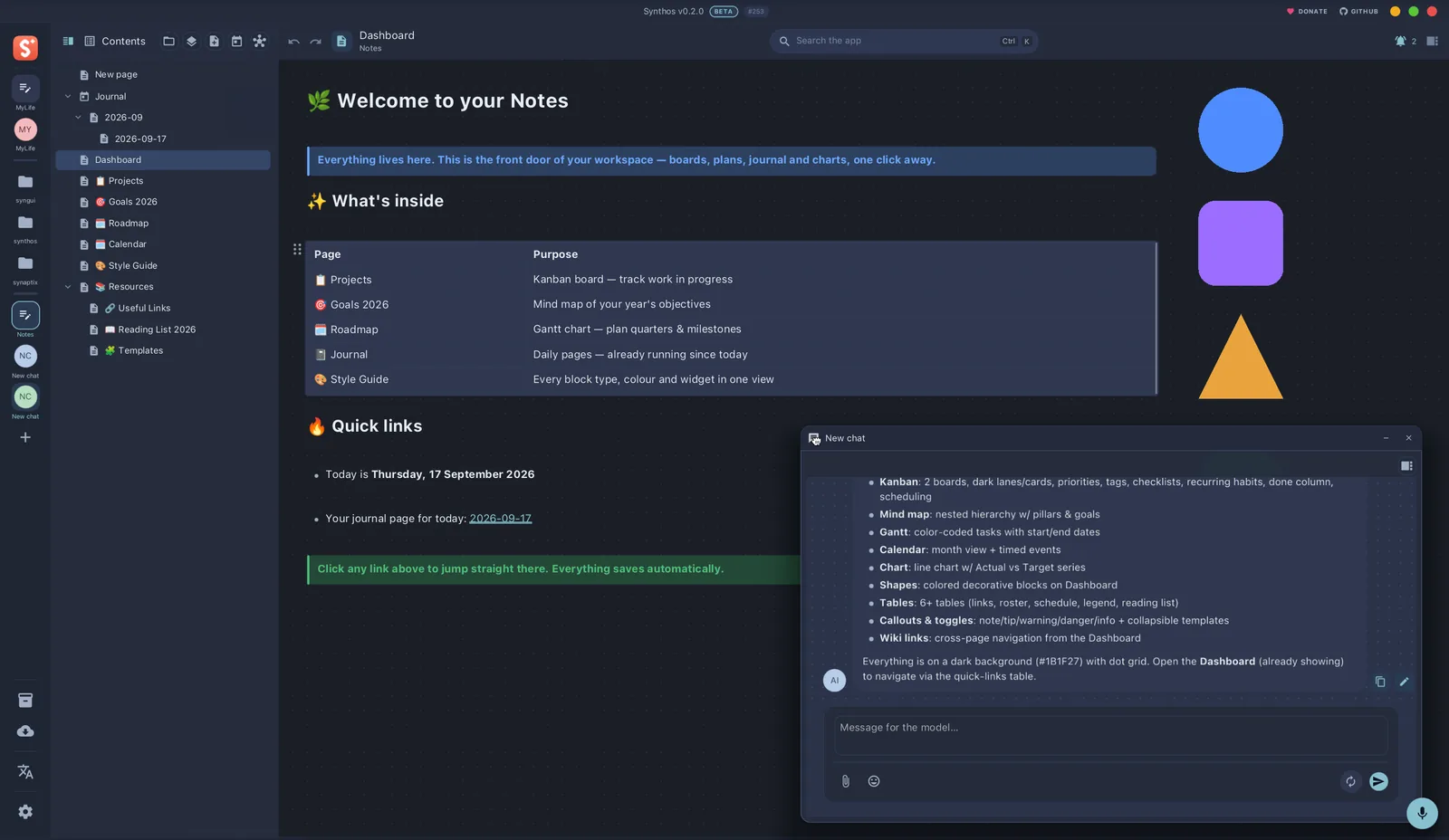
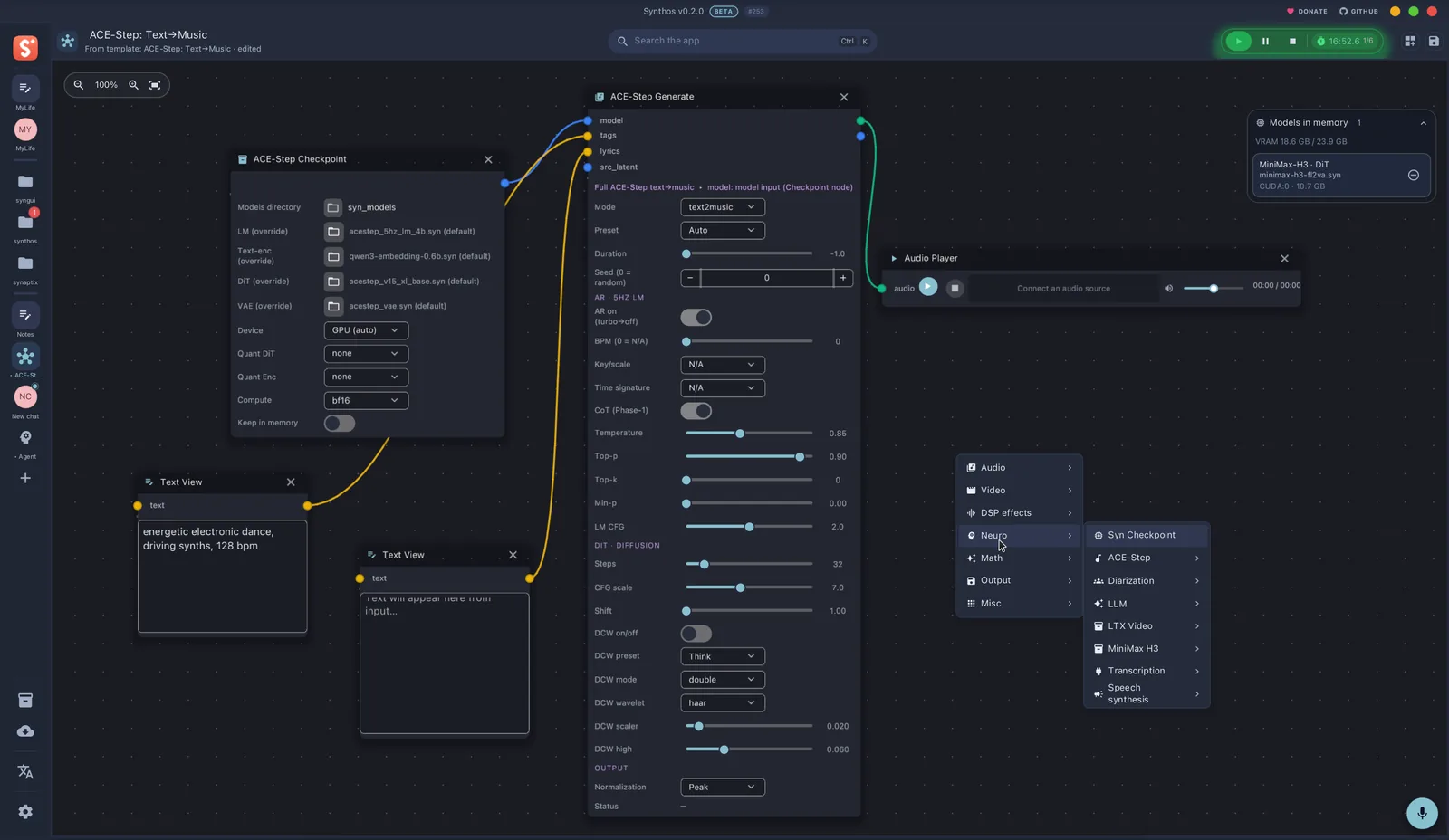
synthos is one desktop app around a local GPU. A chat client runs 27B–125B models from single-file .syn bundles or GGUF files and drives the rest of the app through tools; a notes mode holds your documents, kanban boards, mind maps and calendar in a single project file; a node editor wires generative models into runnable graphs — prompt → image, image + instruction → edited image, text or image → video with sound, lyrics → music, script → multi-voice dialogue, audio → transcript.
The agent can build and run those graphs itself, write into your notes, search your knowledge base and read the web. Everything runs on the device on the native synaptix engine — no Python, no torch, no cloud. Nothing leaves the machine.
Watch it run
Key features
- Chat with Qwen3, the Qwen3.6 / 3.8 hybrids, Qwen3.8-Flash-Next (a 125B MoE that runs on a 24 GB card), Gemma-3, Gemma-4 26B A4B, Muse Glimmer 30B and Llama — with vision where the model has it.
- Native inference: NVFP4, MXFP8, SQ1…SQ8 and all ggml quantization types, CUDA-graph decode, MTP and DFlash speculative decoding, prefix-KV reuse across turns and partial offload of layers to host RAM.
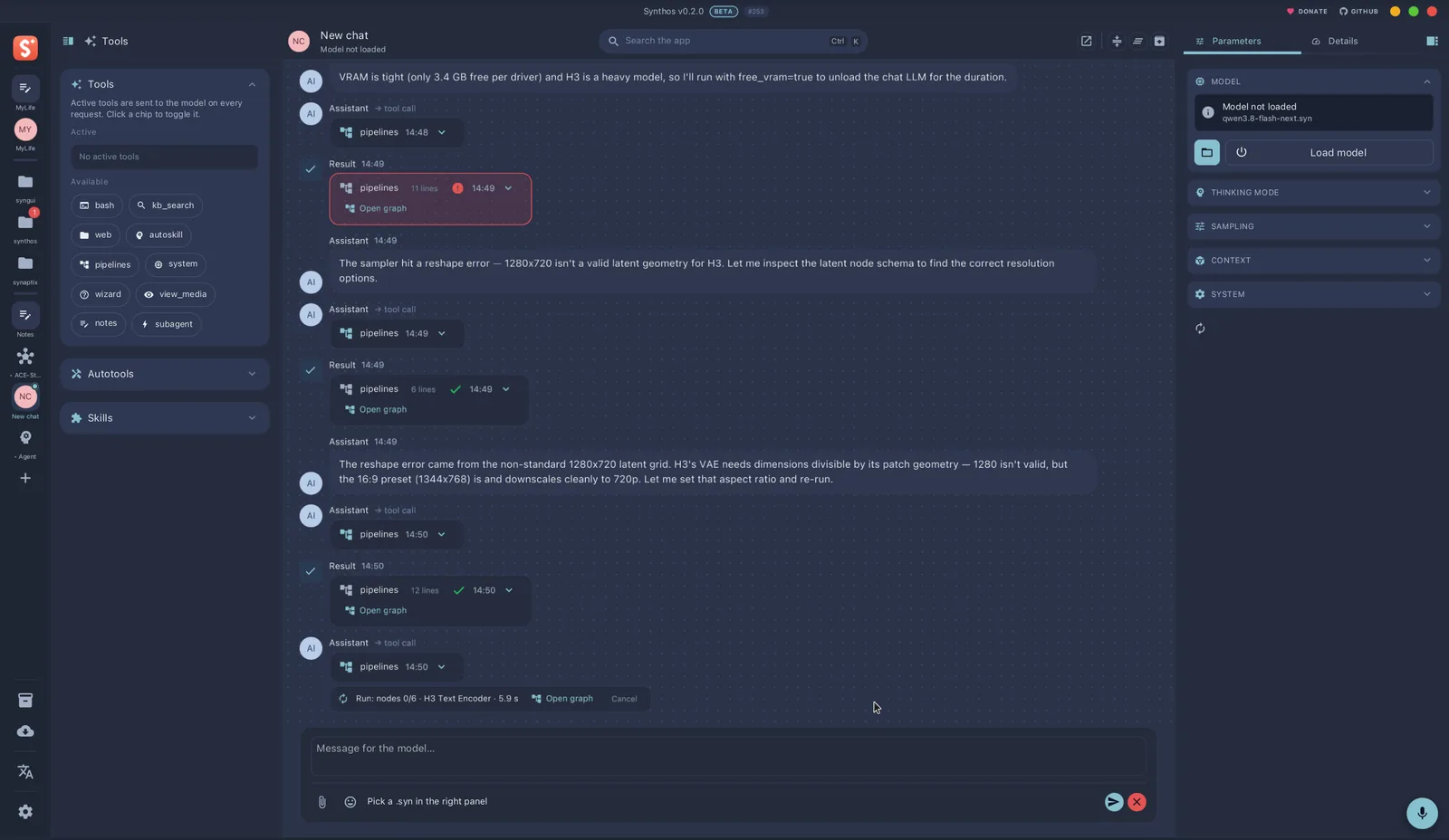
- An agent with tools: web search and reading, knowledge-base retrieval, building and running node graphs, full access to notes, a view_media tool, a wizard that asks you a question mid-turn, subagents and your own skills.
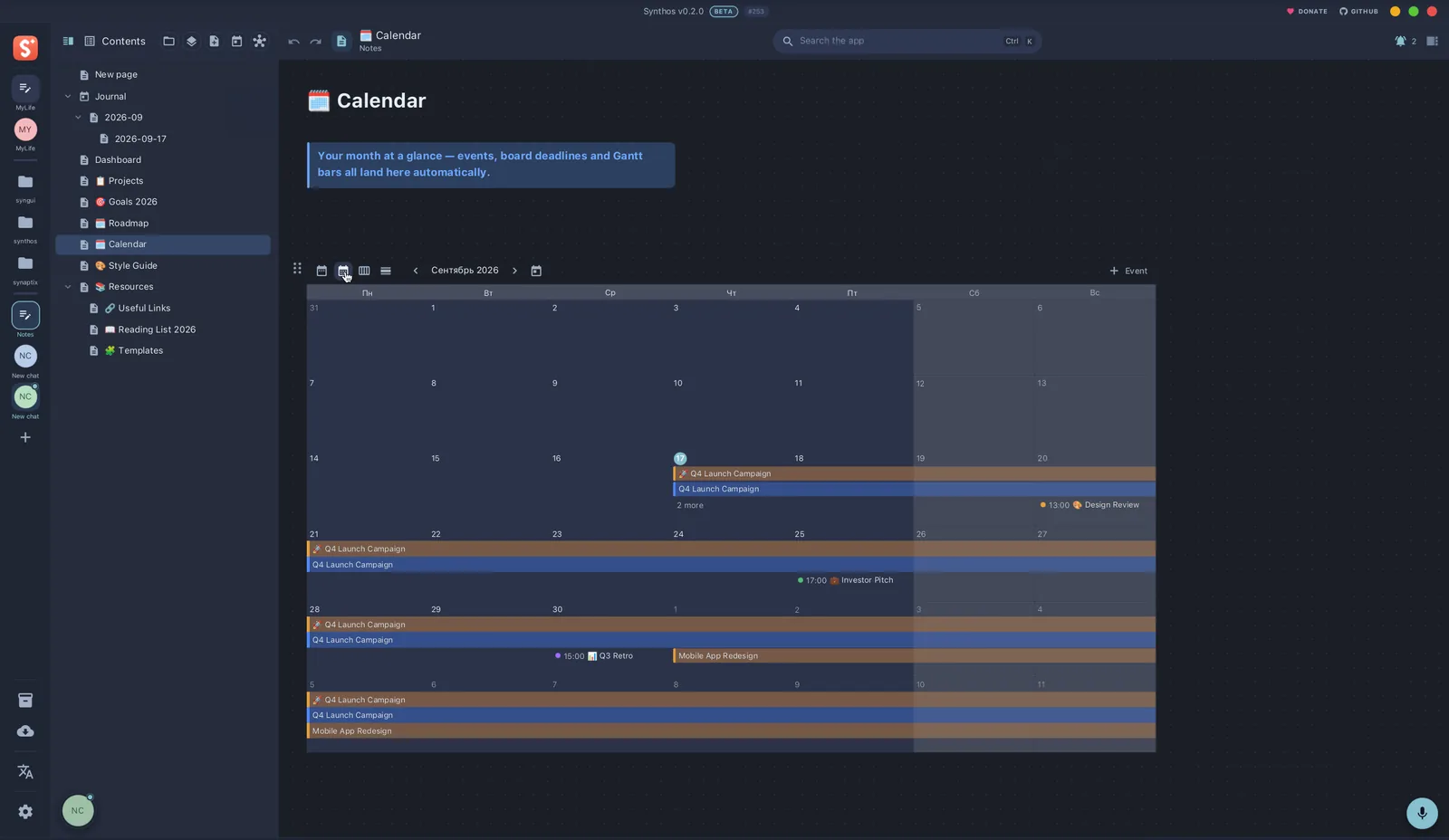
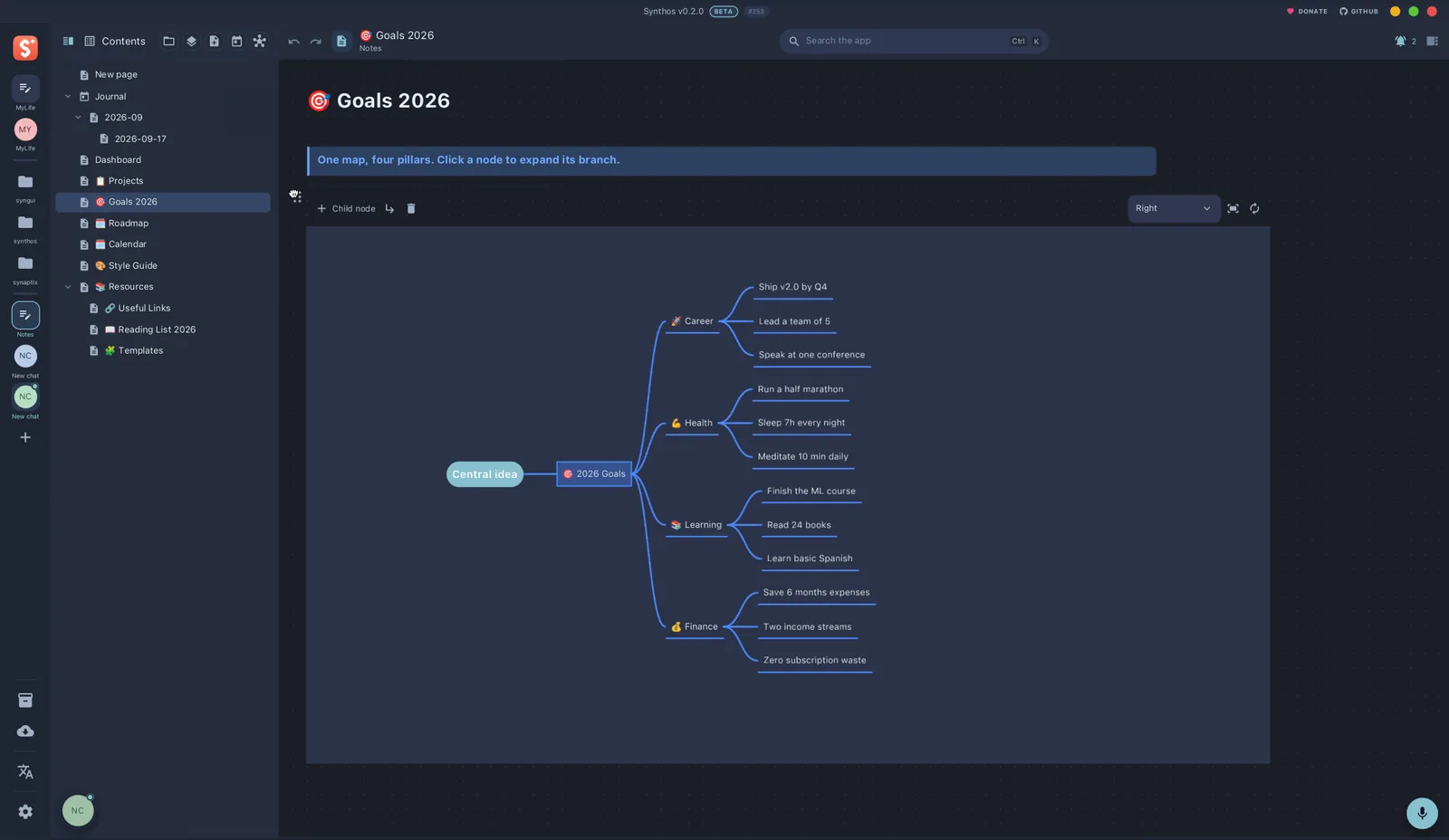
- Notes where a whole project is one .syn file: a WYSIWYG block editor over Markdown, flow or free-canvas pages, kanban boards, Gantt charts, mind maps and a calendar with reminders.
- Images: FLUX.1, FLUX.2 (dev, klein 4B / 9B), Qwen-Image 2.1, Qwen-Image-Edit 2509 / 2511 and SDXL.
- Video: LTX-2.3 (text, image or audio to video, IC-LoRA control) and MiniMax-H3 with synchronized stereo audio and image / video / audio references.
- Music and speech: YuE2 songs through an editable ABC score and covers of a recording, ACE-Step, VoxCPM2 and OmniVoice voice cloning, VibeVoice multi-speaker dialogue, GigaAM transcription, Sortformer diarization.
- A local knowledge base (RAG): files, folders, PDF and URLs, hybrid BM25 + vector search with an optional rerank, stored in bundled SQLite.
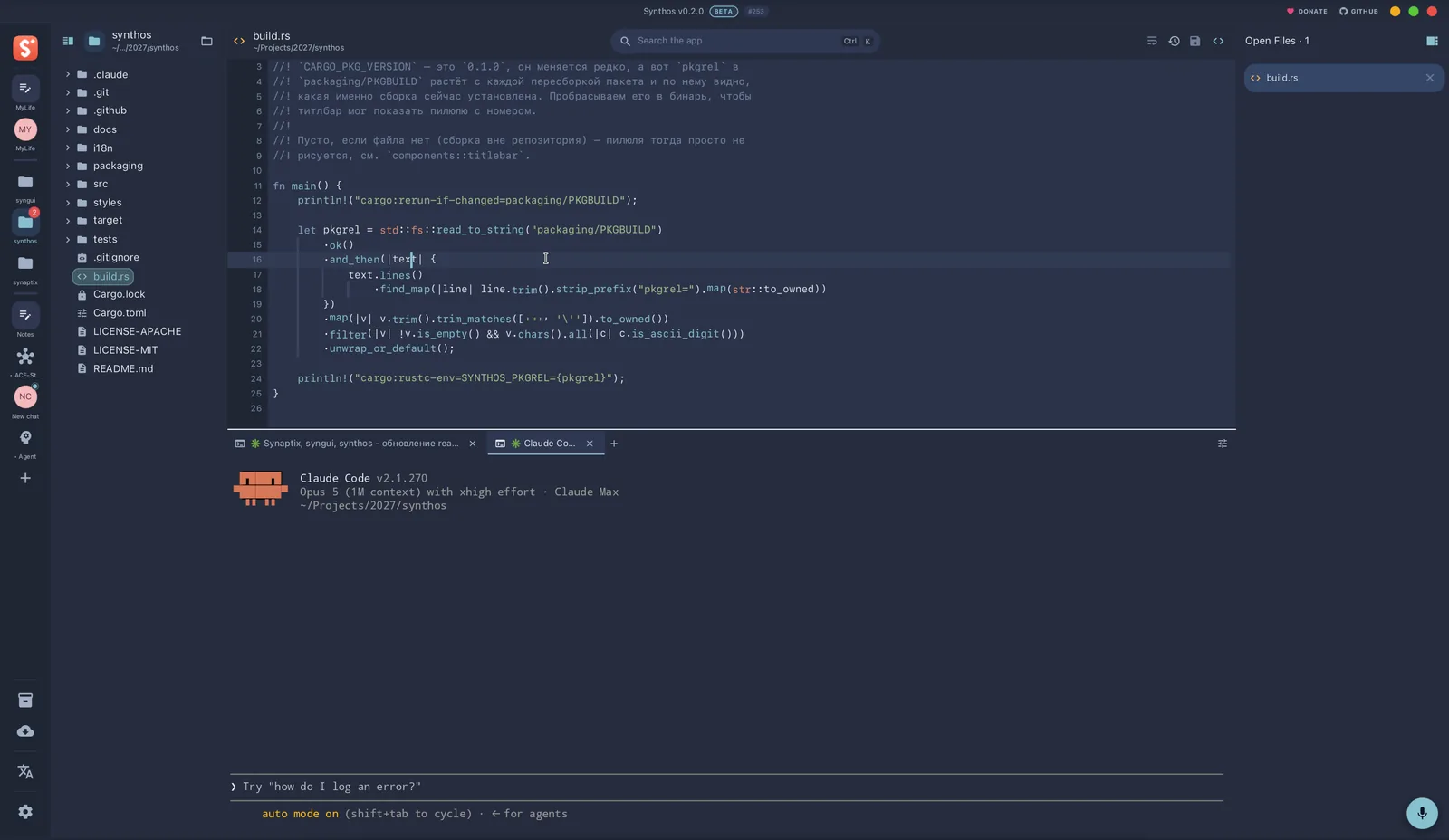
- A code editor with git-status decorations and integrated terminals that run full-screen TUIs.
- A Hugging Face browser with a download dock, in-app packing of models into .syn with per-layer-group quantization, and an interface in 14 languages.
Measured performance
| Model | Prefill | Decode | Notes |
|---|---|---|---|
| Gemma-4 26B A4B | 10 100 tok/s (4k) | 210 tok/s | |
| Qwen3.8-27B hybrid | 1 450 tok/s (3.3k) | 47 tok/s | MTP + CUDA graph |
| Qwen3.8-Flash-Next 125B MoE | 1 650 tok/s @ 260k | 17–22 tok/s | 262k context on 24 GB |
A 3k-token follow-up turn on top of an 80k history takes 3.3 s thanks to prefix-KV reuse. Images at 1024²: SDXL 30 steps in 6.5 s, Qwen-Image 2.1 40 steps in 30 s (MXFP8) or 23 s (NVFP4).
Measured on an RTX 5090 Laptop GPU (24 GB) with 93 GB of system RAM, Arch Linux.
Install
paru -S synthos-bin   # prebuilt binary — recommended
paru -S synthos-git   # build from source (CUDA toolkit, ~2 h, ~15 GB disk)
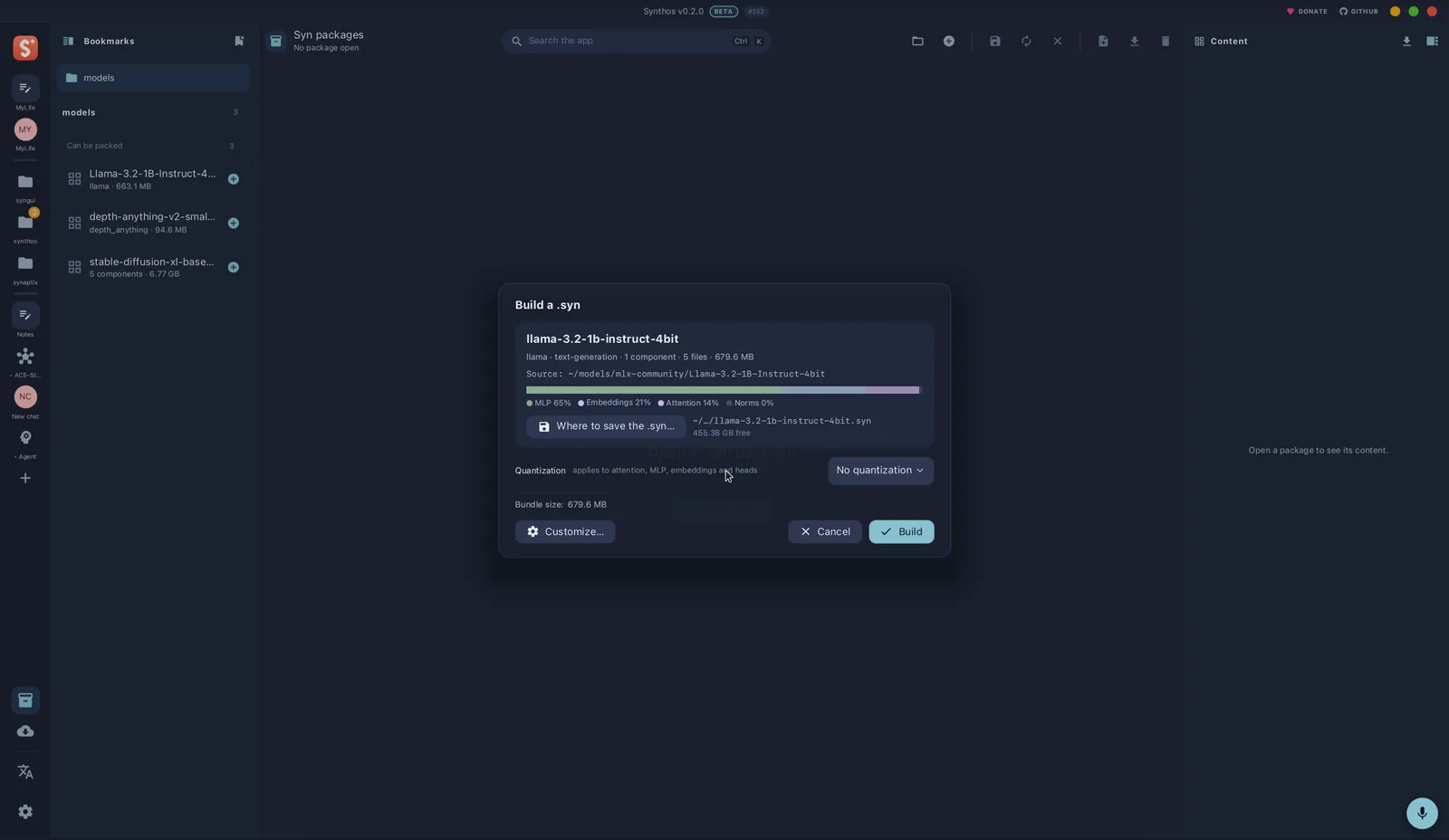
Other distributions: download the tarball from Releases or build from source — the binary is built against Arch library versions. Models downloaded from Hugging Face are packed once into a single .syn file (Syn packages → Build a .syn); GGUF chat models open directly.
Requirements and limitations
- Linux x86_64 only. Runtime: gtk3, wayland, libxkbcommon, fontconfig, a Vulkan driver, alsa, ffmpeg.
- An NVIDIA GPU from sm_80 (Ampere) up. Native NVFP4 / MXFP8 tensor-core paths need Blackwell (sm_120+); older cards run through portable kernels.
- 7 GB of VRAM is enough to run everything, 24 GB to run it quickly: on 7 GB a 27B hybrid answers at 1–2 tok/s.
- No AMD (ROCm) or Apple (Metal) support. A Windows build is planned but does not exist yet.
- No model weights are shipped: you download them yourself and accept each model's licence — some are non-commercial.
- Early stage: one developer, one machine (RTX 5090 Laptop, 24 GB, Arch Linux). How it behaves on other GPUs and distributions is not known yet — bug reports with hardware details help most.
Screenshots
- (open full size)
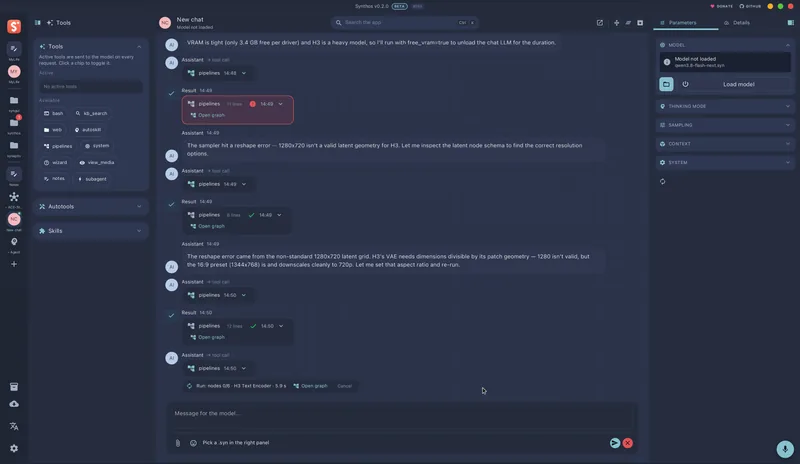
The agent runs a MiniMax-H3 video pipeline, hits a latent-shape error and fixes the resolution itself - (open full size)
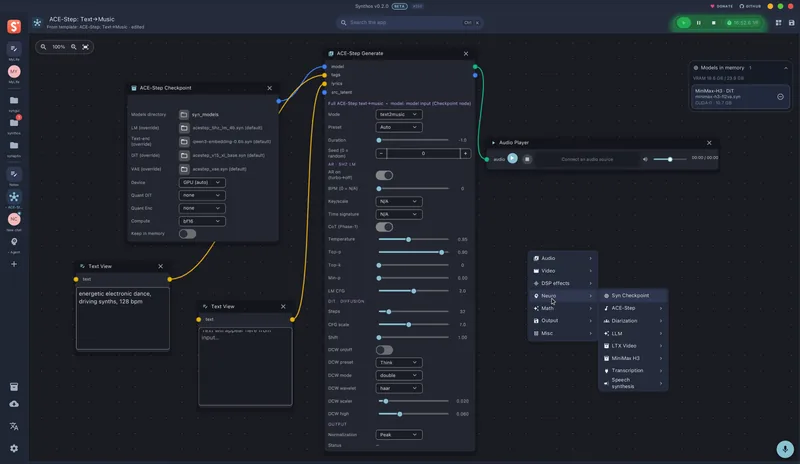
The node editor: the Neuro node menu, a running graph and the models-in-memory panel - (open full size)
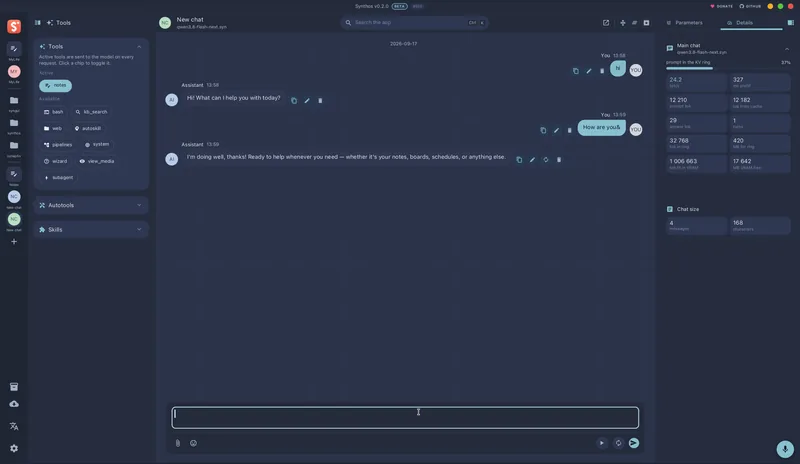
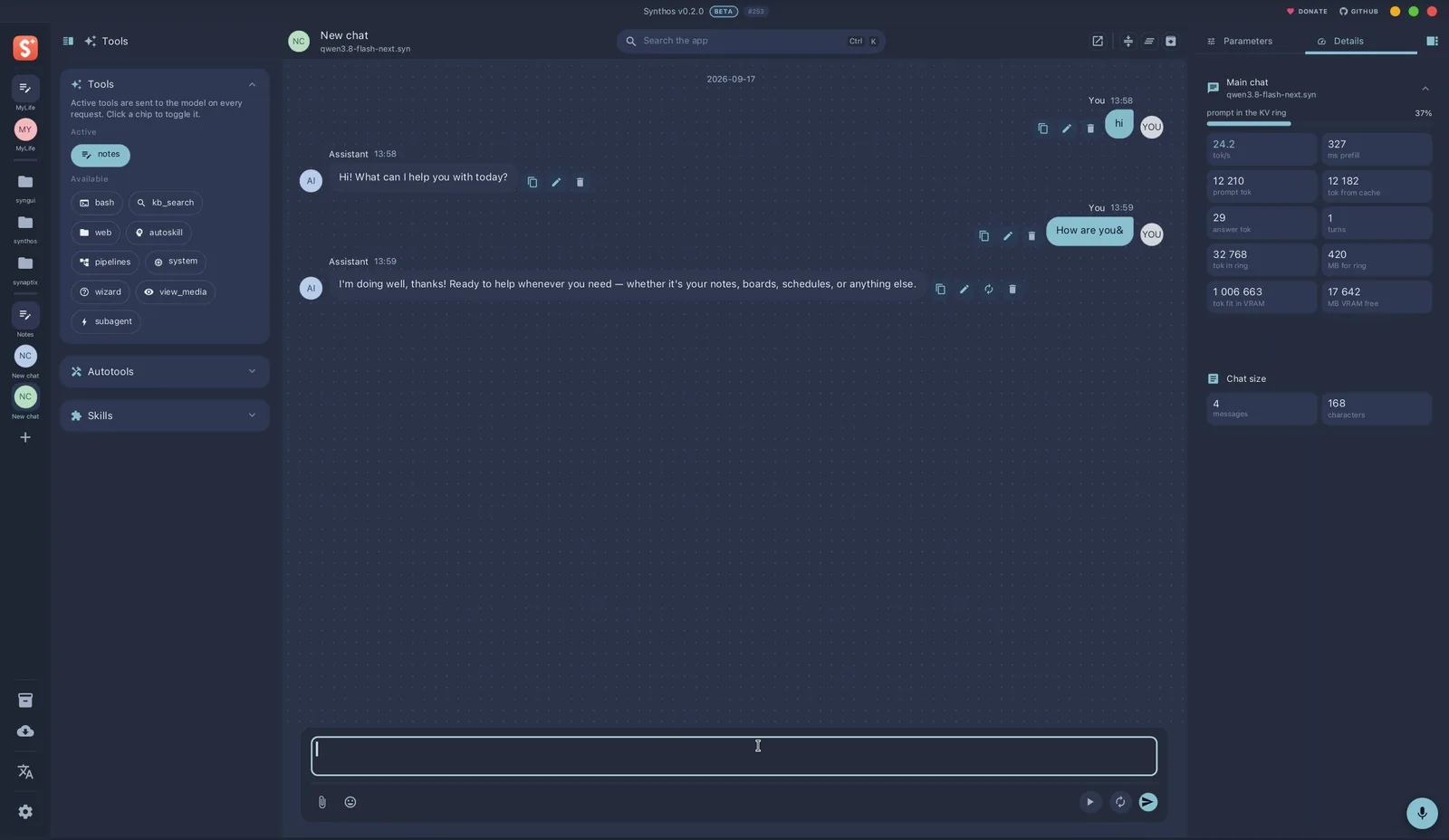
Chat details: tok/s, prefill time and how much of the prompt came from the prefix-KV cache - (open full size)
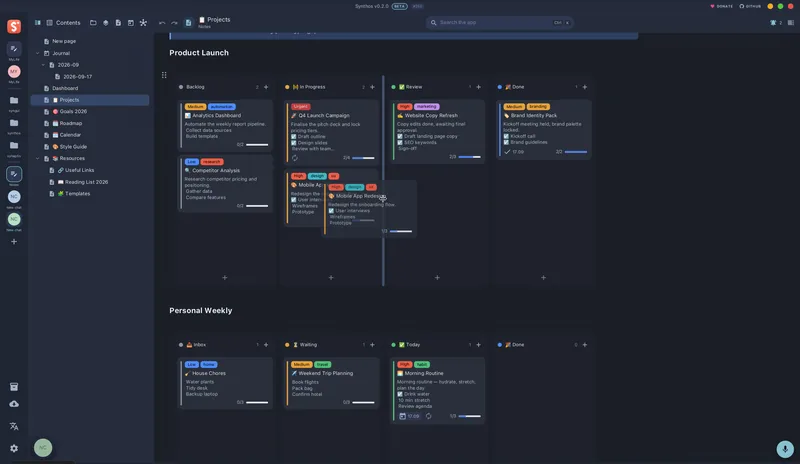
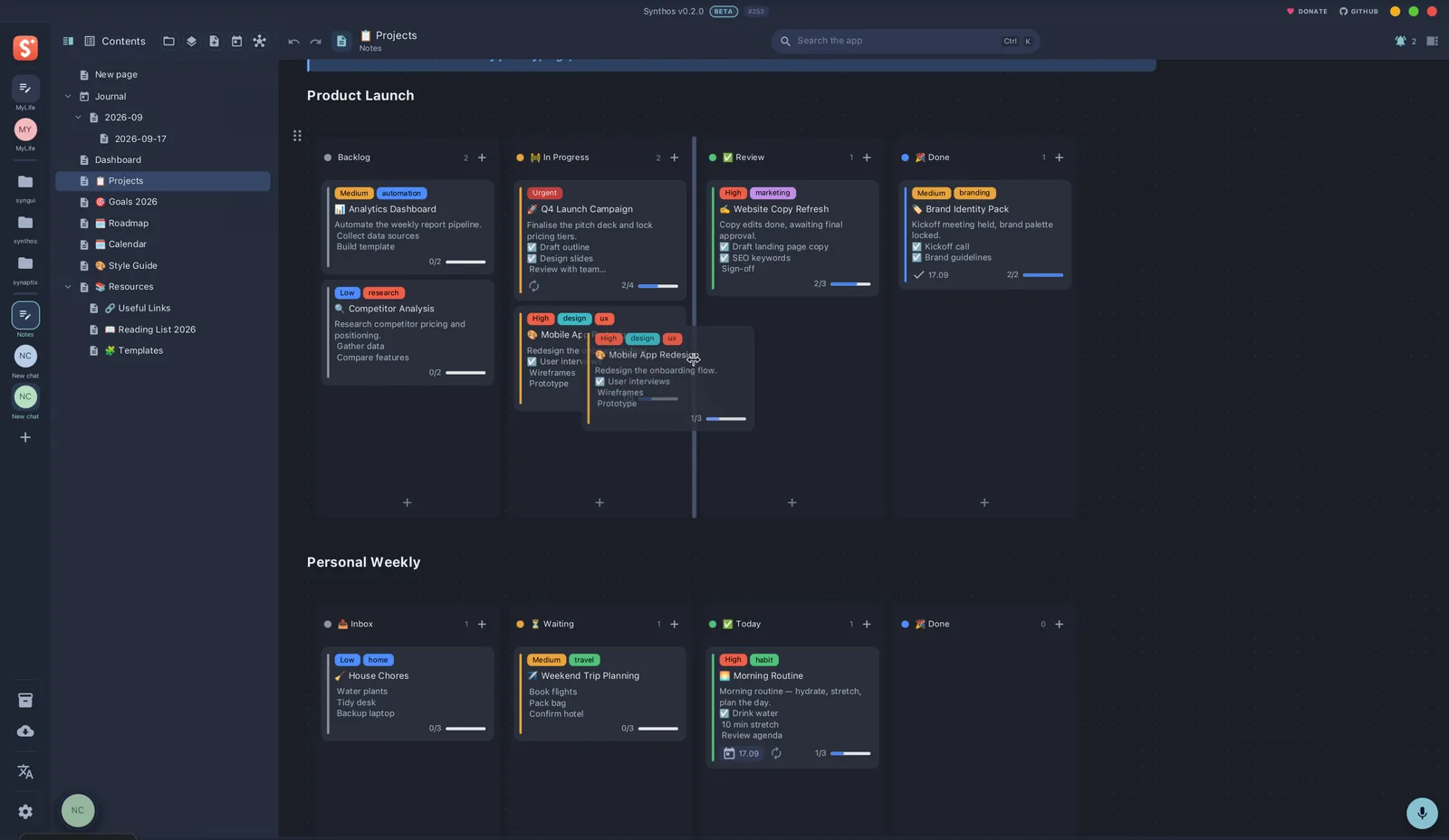
Kanban boards with labels, priorities and checklists — a card mid-drag - (open full size)
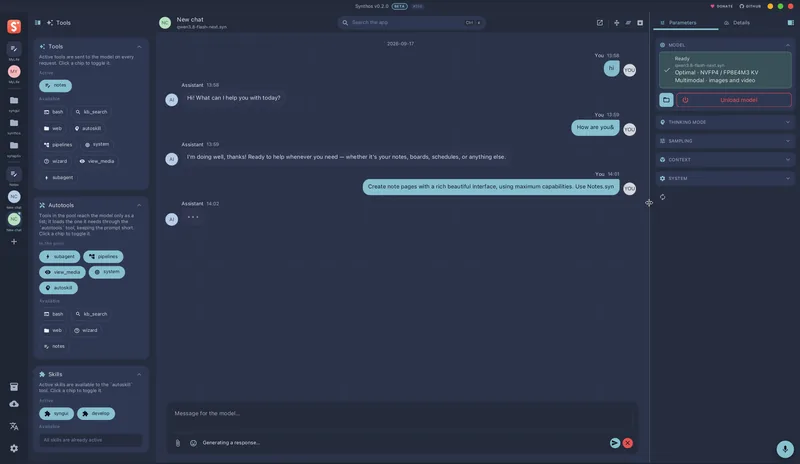
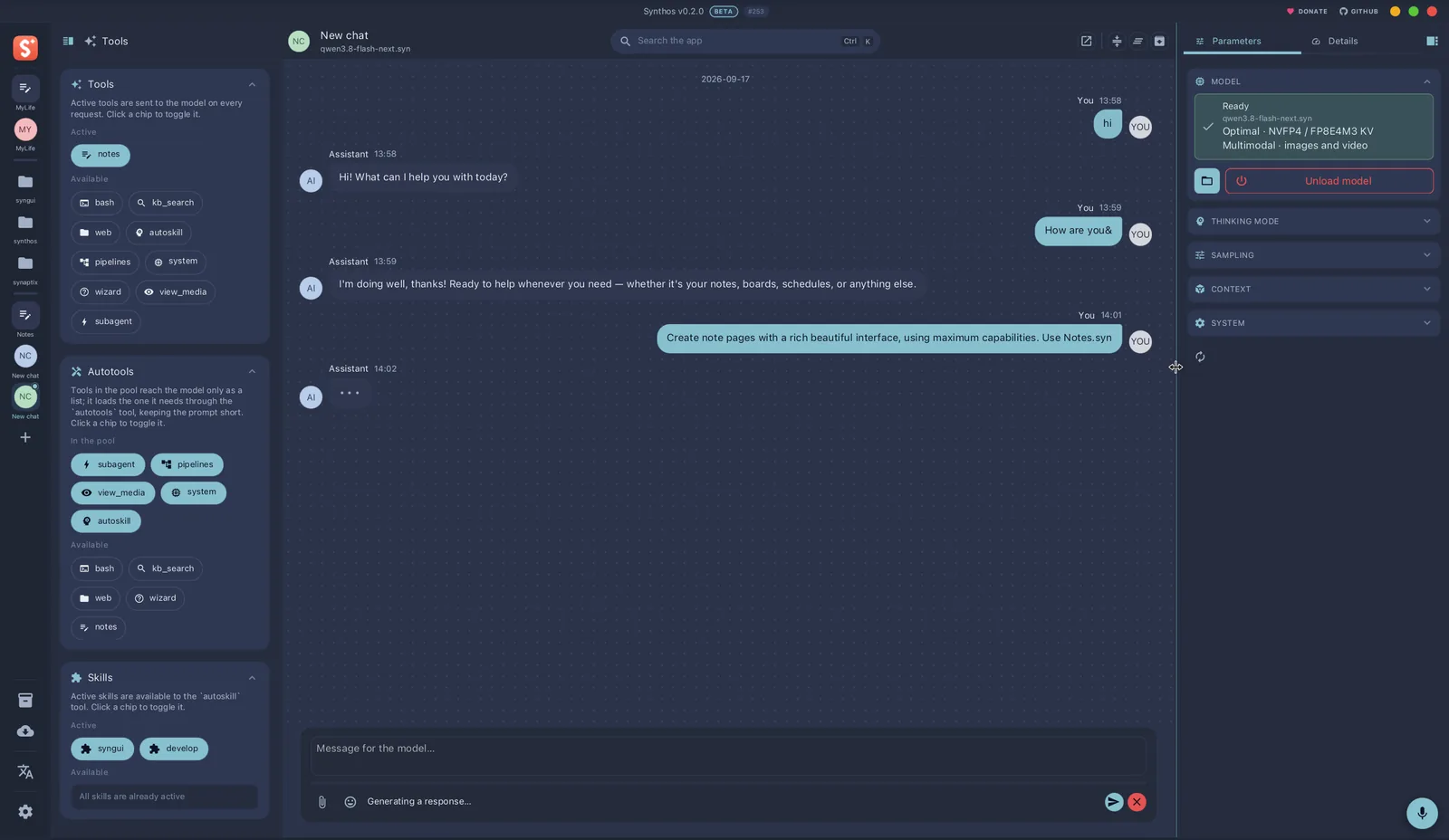
Tools, the autotools pool and skills, toggled per chat - (open full size)
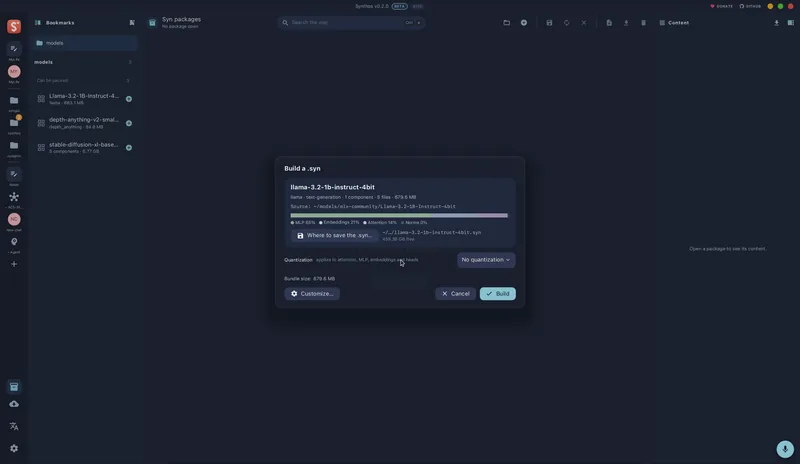
Build a .syn: the model is recognised by itself; pick where to save and, optionally, a quantization - (open full size)
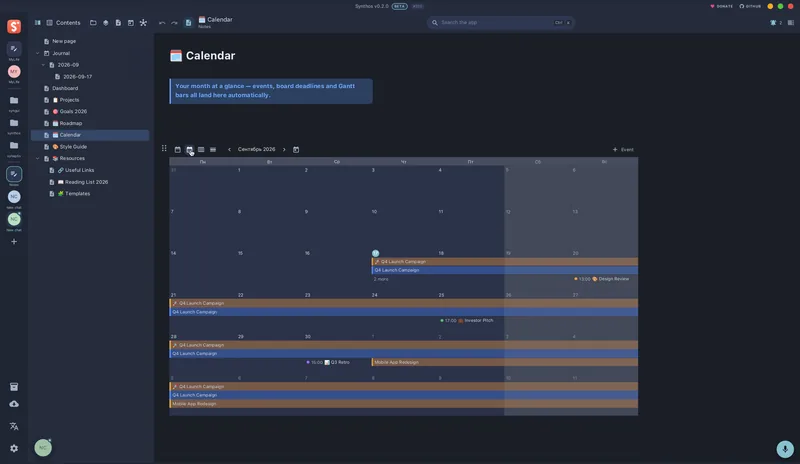
Calendar, month view — events, board deadlines and Gantt bars - (open full size)
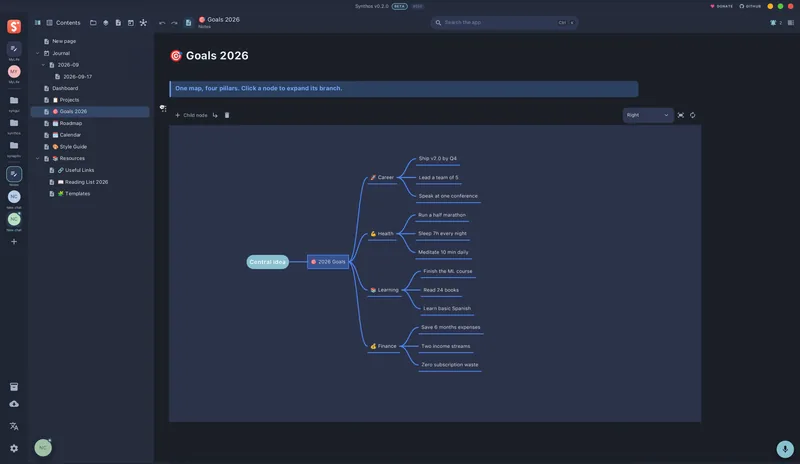
Mind map in notes - (open full size)
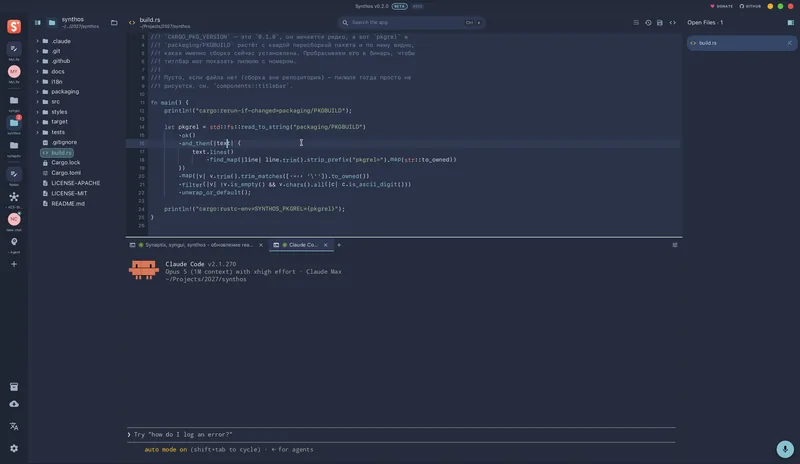
Code editor with the integrated terminal
Vibe-coded with Claude Code
How it is built
The model writes the code, the tests and most of the documentation; I decide what to build, review it and measure it. Every number in the README was measured on my machine, with the losses reported next to the wins. synthos is my own daily code editor and chat.